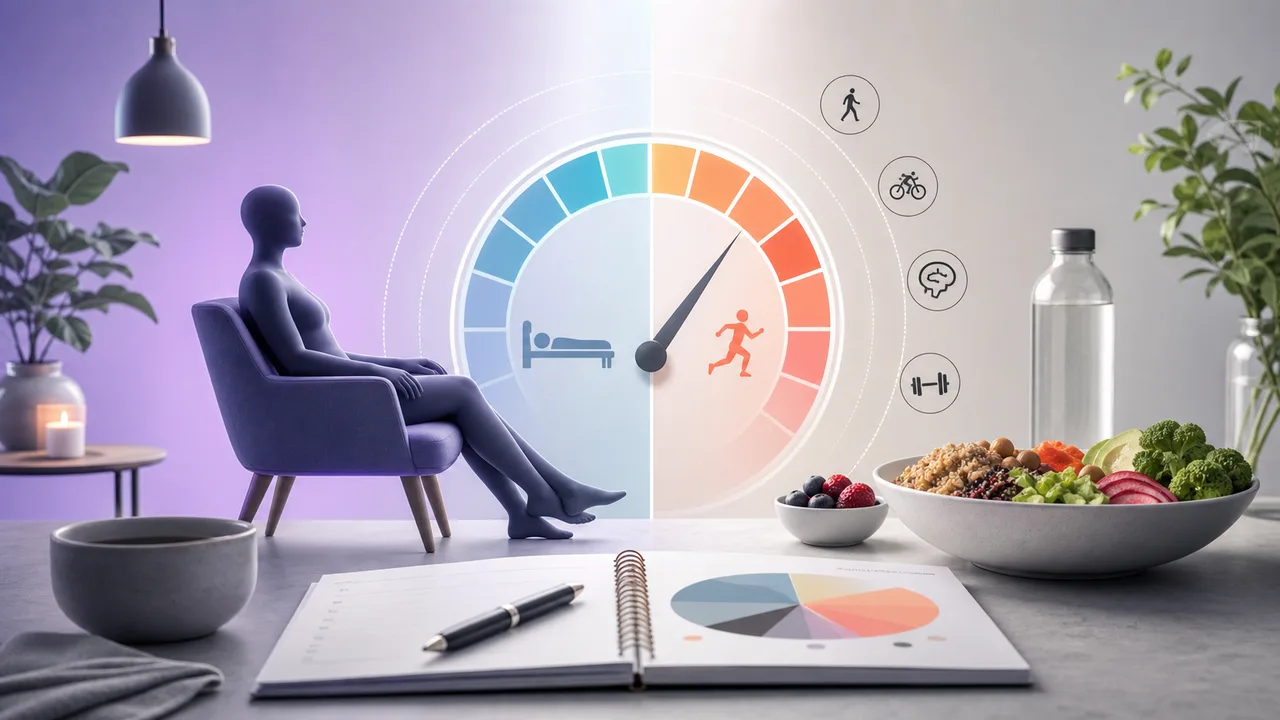
What Is BMR and How to Calculate It
Your BMR is the calories your body burns at rest. Learn how to calculate it, what affects it, and how it guides your diet.
BMR — your Basal Metabolic Rate — is the number of calories your body burns just to stay alive at complete rest. Knowing it is the foundation of any sensible plan to lose, gain or maintain weight, because it tells you the minimum energy your body needs each day.
What BMR really measures
Even while you sleep, your body spends energy on breathing, circulating blood, and repairing cells. BMR captures exactly that baseline. Add your daily activity on top and you get your total calorie needs, known as TDEE (Total Daily Energy Expenditure).
The formula most experts use
The trusted Mifflin-St Jeor equation estimates BMR from four inputs: your weight, height, age and sex. It is more accurate than older formulas, which is why most calculators and dietitians rely on it today.
What affects your BMR
- Muscle mass — more muscle burns more calories at rest.
- Age — BMR gradually falls as you get older.
- Sex — men usually have a higher BMR than women.
- Body size — larger bodies need more energy.
BMR vs TDEE
| Term | What it is |
|---|---|
| BMR | Calories burned fully at rest. |
| TDEE | BMR plus your daily activity. |
Remember it is an estimate
BMR formulas give a close estimate, not a lab-precise number. Use it as a starting point and adjust based on real results over a few weeks.
Calculate yours instantly
You do not need to do the arithmetic yourself. Our BMR and calorie calculator gives both your BMR and daily calorie needs in one click, and to check whether your weight sits in a healthy range the BMI calculator is a useful companion. For trustworthy, science-based guidance, the U.S. National Institute of Diabetes and Digestive and Kidney Diseases publishes free resources at NIDDK.nih.gov. Know your baseline, then plan your meals around it.
Calculate the estimate step by step
The Mifflin–St Jeor equations use kilograms, centimetres and complete years. For men, the estimate is 10 × weight + 6.25 × height − 5 × age + 5. For women, the final constant is −161. A 35-year-old man who weighs 80 kg and is 180 cm tall therefore has an estimated resting expenditure of 1,755 kcal/day.
This is a prediction, not a measurement. The original equation was derived from measured resting energy expenditure in 498 adults, and accuracy varies between individuals and populations. Indirect calorimetry performed under controlled conditions is the usual measurement method when clinical precision matters.
Do not eat “at BMR” automatically
BMR covers essential resting functions; it is not a complete daily calorie target. Walking, work, exercise and digestion raise total expenditure. Activity multipliers give a rough TDEE, but labels such as “moderately active” are easy to overestimate. Track body-weight trends and normal food intake for several weeks before making small adjustments.
When the estimate needs professional context
Pregnancy, growth, eating disorders, thyroid disease, major illness, medication and athletic training can make a generic calculator unsuitable. Children and teenagers also need age-specific clinical methods. Speak with a qualified clinician or dietitian before using a calorie estimate to manage a medical condition.
A responsible workflow
- Enter current measurements in consistent units.
- Treat the result as a range, not an exact allowance.
- Estimate activity conservatively.
- Observe trends over two to four weeks under similar conditions.
- Adjust gradually and seek help for unusual symptoms or aggressive goals.
Read the original Mifflin–St Jeor study and compare a dynamic planning model with the NIDDK Body Weight Planner. ToolBlur provides education and estimation, not diagnosis or personalized medical advice.